


Healthcare Quarterly
Reflections From Our Collaborative Journey: A Collective Vision for Palliative Care in Canada
Improving Equity in Access to Palliative Care Program Delivery Team (including* Clarissa Chan, Andrea Coronado, Kristen DeCaria, Emilie Desmottes, Amber Heyd, Mihaela Labbe, Kirstin Loates, Tanya MacDonald, Nicole Robinson, Raquel Shaw Moxam and Lindsay Yarrow)
Abstract
In this concluding article, Healthcare Excellence Canada (HEC) and the Canadian Partnership Against Cancer (the Partnership) reflect on a collective journey with 23 communities across the country to improve equitable access to palliative care. Responding to lessons learned shared throughout this special issue, HEC and the Partnership offer key takeaways and actions to shape a future where everyone has access to safe and high-quality palliative care.
Introduction
To support progress toward the objectives of the Framework on Palliative Care in Canada (Health Canada 2018) and the Federal Action Plan on Palliative Care (Health Canada 2019), Healthcare Excellence Canada (HEC) and the Canadian Partnership Against Cancer (the Partnership) launched the Improving Equity in Access to Palliative Care (IEAPC) collaborative in 2022 with the aim to foster improved access to care for people experiencing homelessness or vulnerable housing (HEC 2026a). This collaborative sought to live the values of inclusion, innovative partnership and meaningful engagement by bringing together health, housing, social service, harm reduction and First Nations, Inuit and Métis partners to co-design community-led solutions grounded in lived experiences. With over $2.2 million in seed funding from Health Canada, this collaborative brought together 23 communities across eight provinces to develop new or adapt locally tailored models of equity-oriented palliative care. A defining feature of the collaborative was its emphasis on learning across communities through coaching, peer-to-peer networking, site visits and an all-teach-all-learn approach. The collaborative also prioritized meaningful engagement of people with lived and living experience and First Nations, Inuit and Métis guidance, including a dedicated Indigenous-centred1 community of practice and evaluation process.
The IEAPC collaborative improved equitable access to care by supporting low-barrier, trauma-informed and culturally safer models that brought care directly to people in shelters, supportive housing, community agencies, homes and outdoor settings. Rather than expecting people to navigate complex health systems, teams focused on meeting people where they were, building trust, integrating health and social supports and addressing practical barriers to care. As a result of the 23 IEAPC initiatives, over 11,000 patients, caregivers and providers were reached. In addition, the collaborative has been able to demonstrate the economic benefit of equity-oriented mobile models of palliative care. A cross-provincial economic analysis demonstrated that equity-oriented mobile models of palliative care have the potential to result in high-quality, safer care while also resulting in considerable cost savings (IEAPC Program Delivery Team 2026). The analysis found cost savings such as $9,600 in net avoided emergency costs per patient who accessed the program studied. At scale, the evaluators found that a $1 million investment in equity-oriented mobile models of palliative care could result in $2.65 million in avoided emergency costs (Edge Health 2026).
Through this work, 11 promising practices were identified as leading innovative equity-oriented palliative care models serving people experiencing homelessness or vulnerable housing in Canada (HEC 2026b). These promising practices highlight key considerations of equity-oriented palliative care to inform the design, delivery and evaluation of initiatives both within and beyond the IEAPC collaborative (see Figure 1). For the 23 teams and their coaches, they have served both as foundation practices as well as inspiration for many of the initiatives supported through the collaborative.
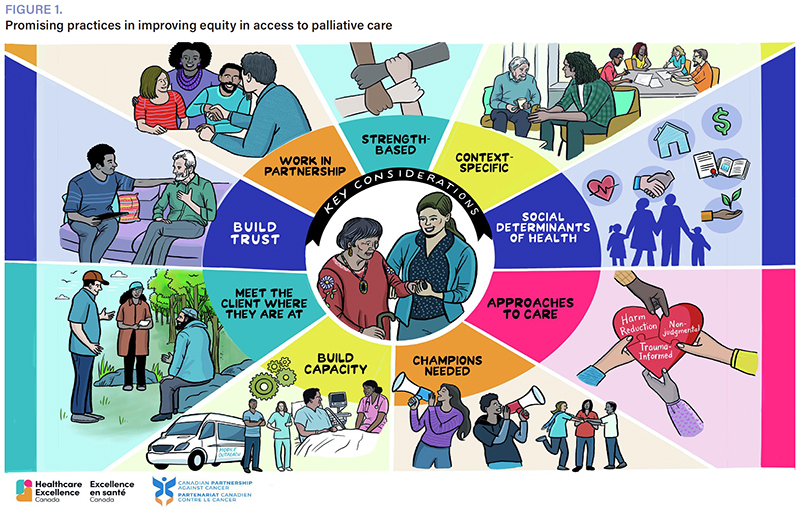
While this special issue describes a collaborative initiative to improve access to equity-oriented palliative care for people experiencing homelessness or vulnerable housing, the implications of this work are transferable across the continuum of care for underserved populations. This special issue features perspectives and key learnings on applying a decolonizing evaluation approach, wise practices for relational engagement, innovative service delivery models, integrating workers with lived and living experience into the care team and grief and bereavement in the context of homelessness.
In this concluding article, we share reflections on the collaborative, our learnings and our shared vision for palliative care in Canada. Beyond this collaborative, we present a series of opportunities for decision makers to consider as we look to shape a future where everyone has access to safe and high-quality care.
Reflections From Our Collaborative Journey
Addressing structural inequities as a foundation for care
A central lesson emerging from the collaborative is that equitable access to palliative care cannot be achieved without addressing the structural and social determinants of health. Across the articles, authors consistently demonstrate that inequities driven by racism, colonization, stigma and social exclusion shape both access to care and health outcomes. Improving access therefore requires models that intentionally respond to the broader realities of people's lives. Diner (2026) shares stories of patients who have accessed care that highlight these inequities and how they drive access and outcomes in care.
Bulle and Dosani (2026) framed how individuals experiencing homelessness or vulnerable housing face unique and often unaddressed challenges in accessing care. They highlighted that effective and impactful models of palliative care delivery must address the social determinants of health as a core component of care delivery and gave us examples of programs that have successfully done this including La Maison du Père in Quebec and George's House in Alberta. Prince (2026) extends this discussion by examining the enduring impacts of colonization on First Nations, Inuit and Métis Peoples and the need to address structural barriers to care. Similarly, Stajduhar (2026) emphasizes that equity-oriented palliative care must place the social determinants of health at its centre, noting that interventions that fail to do so risk perpetuating inequities rather than reducing them.
Collectively, these contributions reinforce a key lesson from IEAPC: equity-oriented palliative care is a person-centred approach that recognizes and responds to the conditions that shape people's ability to access care.
Designing context-specific and wholistic models
A second theme across the special issue is the importance of designing palliative care models that are responsive to local context. Rather than promoting a single model of care, the authors emphasize the value of common principles that can be adapted to meet the unique needs, strengths and priorities of individual communities.
For example, we know that care in rural and remote communities may inherently look different than care in urban centres as the resources and strengths of each of these communities are unique (CIHI 2023). As Stajduhar (2026) explained, equity-oriented palliative care goes beyond mainstream approaches to recognize and address system barriers, requiring a shift toward developing policies and programs with the needs of those who are underserved in mind. Building on this concept, Bulle and Dosani (2026) identify four emerging approaches across the IEAPC collaborative: mobile-based care and outreach services, equity-oriented clinical pathways, bed-based end-of-life care and capacity-building through engagement. While these approaches differed across communities, they shared a commitment to reducing barriers, meeting people where they are and leveraging local strengths and partnerships. This diversity reflects one of the collaborative's key learnings: successful models are community-driven rather than prescribed. The ability of teams to adapt principles to their local context enabled innovation and responsiveness, while remaining grounded in a shared commitment to equity.
Flexible and inclusive approaches to evaluation
The special issue also highlights the importance of evaluation approaches that reflect the complexity, diversity and relational nature of equity-oriented work. Many existing evaluation methods alone may not adequately capture community impact, relationship-building, cultural relevance, local definitions of success or the ways change unfolds within complex systems. Instead, evaluation must be responsive to context, meaningful to communities and capable of integrating multiple forms of knowledge and evidence (Ward et al. 2018).
The IEAPC Evaluation Framework (HEC and CPAC n.d.), described by the IEAPC Program Delivery Team (2026), was intentionally designed as a flexible roadmap rather than a prescriptive reporting tool. Developed through a co-creation process involving community teams, advisers with lived and living experience, Elders, First Nations, Inuit and Métis advisers and subject matter experts, the framework was grounded in principles of equity, collaboration, adaptability and relevance. Recognizing that communities varied significantly in evaluation readiness, resources and capacity, the framework allowed teams to document and interpret progress in ways that reflected their local context while remaining aligned with shared goals of improving equity, safety and quality of care.
Caverley (2026) further expands on these ideas by emphasizing the importance of decolonizing evaluation practices. Through the Indigenous-centred community of practice, evaluation incorporated storytelling, art, metaphor, community reflection and Indigenous ways of knowing alongside more mainstream measures. These approaches challenged traditional assumptions about what constitutes evidence and demonstrated how evaluation can honour culture, relationships, lived experience and community knowledge while still generating valuable insights for improvement.
Collectively, this approach demonstrates that evaluation is most effective when it is adaptable, inclusive and grounded in the realities of the communities involved. Flexible evaluation approaches that value relationships, local context, multiple ways of knowing and both process and outcome measures are required for understanding and advancing equitable access to care.
Building relationships and working in partnership
Across the articles in this special issue, relationships emerge as a foundational requirement for improving equitable access to care. Several authors emphasize the building or rebuilding of trust and development of relationships between individuals, communities and the healthcare system as well as partnering in meaningful ways to collectively leverage community strengths to improve access to care. In part, this involves deep consideration of the historical and ongoing impacts that contribute to mistrust in the healthcare system for many underserved groups (Diner 2026; Prince 2026). Caverley (2026) reinforced this in her article, where she highlights a key evaluation finding that relationships are the foundation of meaningful palliative care.
It is well known that access to First Nations, Inuit and/or Métis-led and culturally safer palliative care is lacking with disparities often being even more pronounced in rural and remote areas where individuals have to travel outside of their communities to access care in settings that can be unsafe (CIHI 2023). Prince (2026) discusses the necessity of building trust and establishing meaningful partnerships with First Nations, Inuit and Métis in the journey toward more equitable and culturally safer care. But before this can happen, Prince reinforces that pre-engagement work is a requirement of organizations and individuals including examples such as engaging in critical self-reflection, cultural safety training and learning about the historical and ongoing impacts of colonialism as precursors to effective engagement and relationship building. Caverley demonstrates what this work can look like through the lens of five teams via the Indigenous-Centered community of practice and shares lessons learned that can be incorporated into future work, including putting relationships first, keeping culture at the centre and finding ways to honour spirit, relationships and community.
Partnerships are also highlighted as critical at organizational and system levels. Stajduhar (2026) highlights the responsibility of healthcare leaders to establish meaningful partnerships with community-based organizations that already serve people experiencing homelessness or vulnerable housing. These organizations often have the closest connection to underserved populations but may lack the capacity to provide palliative approaches to care without healthcare system partners. This is consistent with findings from Black et al. (2026), indicating the need for greater collaboration between housing services/shelters and grief and bereavement organizations as a shared opportunity to build capacity and improve supports.
Relationship building and partnership must also occur at the interdisciplinary team level. Diner (2026) highlighted how inaccessible the healthcare system can be for people experiencing structural vulnerabilities. Workers with lived and living experience offer the human connection, dignity and compassion needed to establish trusting relationships and can leverage their expertise to bridge care gaps.
Strength-based approaches and meeting people where they are at
Finally, the special issue highlights the importance of approaches that recognize people's strengths, dignity and humanity. Across diverse models and settings, authors consistently emphasize that equitable care requires providers to meet people where they are.
Diner (2026) shares her experience of working within the system, providing a rich illustration of the importance of meeting people where they are at, both figuratively and literally. Compounded by racism, discrimination and stigma from previous experiences in institutional settings, workers with lived experience recognize and understand that building trusting relationships takes time and can be the difference between someone continuing with care or walking away. Recognizing and valuing the inherent strengths, dignity and humanity of each person is fundamental in this effort.
Bulle and Dosani (2026) identify approaches such as trauma-informed care and harm reduction as foundation principles in many collaborative initiatives and promising practices, stating “by acknowledging the complex realities faced by structurally vulnerable populations, these initiatives provide care that is rooted in love, dignity and understanding, rather than judgement or exclusion.” (p. 32)
The importance of supporting not only individuals but also families, chosen families, communities and care providers is further reinforced by Black et al. (2026), who highlight the often-overlooked impact of grief and bereavement among people experiencing homelessness. They remind us that supports must be flexible, culturally safe and delivered by trusted community members. Similarly, Caverley (2026) underscores the role of community, connection and Indigenous ways of knowing in fostering healing, belonging and compassionate care.
Taken together, these reflections suggest that equity-oriented palliative care is most effective when it builds on individual and community strengths, honours relationships and adapts care to the realities of people's lives rather than expecting people to adapt to the system.
Advancing Equity in Access to Palliative Care in Canada
As we conclude this special issue, we outline the conditions required to advance equitable access to palliative care in Canada.
-
Support the implementation, spread and scale of equity-oriented models of palliative care in familiar and trusted settings
The current palliative care system is highly integrated in mainstream healthcare, including hospitals and home care where substantial structural barriers to care exist for people experiencing homelessness or vulnerable housing and other structurally vulnerable populations. Equity-oriented mobile models of care are just one example of how care outside of hospital can help us improve access to care. Across the IEAPC collaborative, teams that served patients directly delivered care in community agencies, shelters, supportive housing and other non-traditional settings, reaching more than 11,000 patients and caregivers who may otherwise have remained disconnected from care. Through outreach services, home visits, community paramedicine programs and improved clinical pathways and coordination among providers, individuals were able to receive support earlier and in settings that aligned with their needs (IEAPC Program Delivery Team 2026). Economic evaluation findings from mobile-based palliative care models demonstrate that equity-oriented mobile palliative care models could avoid approximately $9,600 in emergency healthcare costs per patient accessing the program and generate a positive return on investment (HEC and CPAC 2026; IEAPC Program Delivery Team 2026).
-
Develop care pathways that offer low-barrier services to individuals experiencing structural vulnerabilities
In many provinces and territories, palliative care referral pathways are limited through traditional homecare services, creating further structural barriers with respect to access. Creating low-barrier referral processes and embedding care where individuals with structural vulnerabilities already receive care and feel safe can improve access to and quality of care delivered. Evaluation findings from mobile and outreach teams found that 72% of care recipients surveyed reported they would not have sought care that day if it were not for the local program, highlighting the importance of bringing services directly into communities (IEAPC Program Delivery Team 2026).
-
Design equity-oriented models of care with sustainability in mind to fully realize their benefits
Services and staffing models that provide palliative care to people experiencing homelessness or vulnerable housing and other structurally vulnerable populations need to be embedded in existing healthcare systems and structures and where necessary provided sustainable funding. Providing funding to equity-oriented models has the potential for cost savings across the broader system and ensuring care is delivered in the right place at the right time as shared in the economic evaluation findings above (HEC and CPAC 2026; IEAPC Program Delivery Team 2026).
-
Enable flexible compensation and funding models to improve access to care
Physician compensation models often require clients to be enrolled in a publicly funded provincial/territorial health plan (i.e., have a health card), therefore limiting access to care in the absence of alternative billing options to care for individuals without a health card. Centering care around the individual requires flexibility in billing and funding structures for physician and care teams. IEAPC collaborative teams often shared that administrative barriers, insurance requirements and difficulties navigating healthcare systems can create significant access challenges for people experiencing homelessness, vulnerable housing and other forms of structural vulnerability. Teams consistently emphasized the importance of low-barrier approaches that prioritize patient needs over administrative requirements and enable providers to deliver care in flexible, community-based settings.
-
Expand safer, trauma-informed, culturally responsive care closer to home and community
Improving access to care in rural and remote areas would reduce the number of individuals required to travel outside of their community to access this care. Engaging the community, leveraging interprofessional care models, providing infrastructure to support end-of-life (e.g., pain pumps, narcotics lock boxes in homes), improving cultural safety of care and incorporating Indigenous ways of knowing and doing are just some of the ways we can increase access to care closer to home and community. Within the IEAPC collaborative, over 3,500 individuals received training to strengthen access to palliative care closer to home and community, including harm reduction, cultural safety training and advanced care planning. Across communities, teams consistently identified these approaches as essential to help people feel respected, understood and able to engage in care.
Conclusion
While it is evident that we are not at the finish line, we hope to have illustrated through this special issue that improving access to care and creating an equitable healthcare system is an ongoing collaborative journey. And like most system transformations, it must happen by working together. This collective journey is filled with promise and hope, but to be successful in achieving our intended outcomes, we must be prepared to do things differently. This includes engaging the community, considering new and innovative models of care, building relationships and partnerships, moving beyond the walls of the hospital and bringing care to the places where people are and where they feel safe. We must work across systems with new partners who bring strengths and expertise to this work that may not exist within the healthcare system. We must consider the ongoing and historical impacts of colonization and commit to culturally safer care through meaningful engagement with First Nations, Inuit and Métis and centering their experience and knowledge.
The Federal Framework on Palliative Care outlined a path forward by identifying opportunities for improvement across the healthcare system with reference to existing efforts and best practices to help guide the way. The IEAPC collaborative has provided important insights into the conditions required to advance equitable access to palliative care in Canada. It has accelerated learning, strengthened evidence for effective approaches and demonstrated the value of collaborative action across sectors. While significant work remains, the findings provide a strong foundation for the spread and scale of proven innovations and support ongoing efforts to ensure all people in Canada have access to safe, high-quality palliative care.
Disclaimer
This work is supported by HEC. HEC works with partners across the country to shape a future where everyone in Canada has safe and high-quality healthcare. We bring together people, evidence and action to move Care Forward – spreading and scaling quality and safety improvements, strengthening capacity and collective leadership and catalyzing policy and practice change. HEC is an independent, not-for-profit charity funded primarily by Health Canada. The views expressed herein do not necessarily represent the views of Health Canada.
This work is supported by the Partnership. The Partnership is an independent organization funded by the federal government to accelerate action on cancer control for all Canadians. The Partnership is the steward of the Canadian Strategy for Cancer Control (the Strategy) and works to implement the Strategy to reduce the burden of cancer on Canadians. The partner network – cancer agencies, health system leaders and experts and people affected by cancer – brings a wide variety of expertise to every aspect of our work to support multi-jurisdictional uptake of the knowledge emerging from cancer research and best practices in order to optimize cancer control planning and drive improvements in quality of practice across the country. The views expressed herein do not necessarily represent the views of Health Canada.
About the Author(s)
The Improving Equity in Access to Palliative Care Program Delivery Team includes representatives from Healthcare Excellence Canada (Emilie Desmottes, Amber Heyd, Mihaela Labbe, Kirstin Loates, Tanya MacDonald, Nicole Robinson and Lindsay Yarrow) and Canadian Partnership Against Cancer (Clarissa Chan, Andrea Coronado, Kristen DeCaria and Raquel Shaw Moxam), who have contributed to the strategic development and operationalization of the Improving Equity in Access to Palliative Care pan-Canadian collaborative.
On behalf of HEC and the Partnership, Lindsay Yarrow can be reached by email at ieapc-aeasp@hec-esc.ca or lindsay.yarrow@hec-esc.ca.
*In alphabetical order.
Acknowledgment
The authors would like to extend their gratitude to the IEAPC communities, coaches, advisors, steering committee, Elders and many others who contributed to these learnings, promising practices and the success of the collaborative. It was a true privilege to learn from each of you, and we look forward to continuing to see the impact of your work in the years to come.
References
Black, J., S. Laing, R. Carter, S. Landry, J.R. Graham and E. Hassan. 2026. Grief and Bereavement in the Context of Homelessness: Sharing Experiences and Learnings From British Columbia. Healthcare Quarterly 29(Special Issue): 22–28. doi:10.12927/hcq.2026.27967.
Bulle, S. and N. Dosani. 2026. Reflections on Innovative Models of Palliative Care Delivery. Healthcare Quarterly 29(Special Issue): 29–35. doi:10.12927/hcq.2026.27966.
Canadian Institute for Health Information (CIHI). 2023. Access to Palliative Care. Retrieved March 17, 2025. <https://www.cihi.ca/sites/default/files/document/access-to-palliative-care-in-canada-2023-report-en.pdf>.
Caverley, N. 2026. Many Paths, Walking Together: Honouring Collective Reflections in Indigenous-Centred Palliative Care in Canada. Healthcare Quarterly 29(Special Issue): 46–56. doi:10.12927/hcq.2026.27964.
Diner, J. 2026. Bridging the Gap: Why Lived Experience Is Essential in Palliative Care for the Unhoused. Healthcare Quarterly 29(Special Issue): 11–14. doi:10.12927/hcq.2026.27969.
Edge Health. 2026. Report on Equity-Oriented Mobile-Based Palliative Care Programs in Canada [Internal Report].
Health Canada. 2018. Framework on Palliative Care in Canada. Retrieved February 25, 2025. <https://www.canada.ca/content/dam/hc-sc/documents/services/health-care-system/reports-publications/palliative-care/framework-palliative-care-canada/framework-palliative-care-canada.pdf>.
Health Canada. 2019. Action Plan on Palliative Care: Building on the Framework on Palliative Care in Canada. Retrieved February 25, 2025. <https://www.canada.ca/content/dam/hc-sc/documents/services/health-care-system/reports-publications/palliative-care/action-plan-palliative-care/action-plan-palliative-care-eng.pdf>.
Healthcare Excellence Canada (HEC). 2026a. Improving Equity in Access to Palliative Care. Retrieved September 1, 2026. <https://www.healthcareexcellence.ca/en/what-we-do/all-programs/improving-equity-in-access-to-palliative-care/>.
Healthcare Excellence Canada (HEC). 2026b. Promising Practices for Improving Equity in Access to Palliative Care. Retrieved September 1, 2026. <https://www.healthcareexcellence.ca/resources/improving-equity-in-access-to-palliative-care-promising-practices>.
Healthcare Excellence Canada (HEC) and Canadian Partnership Against Cancer (CPAC). 2026, September. Investing in Equity: An Economic Analysis of Equity-Oriented Mobile Palliative Care Models in Canada. <https://www.healthcareexcellence.ca/resources/investing-in-equity>.
Healthcare Excellence Canada (HEC) and Canadian Partnership Against Cancer (CPAC). n.d. Improving Equity in Access to Palliative Care Collaborative Evaluation Framework. Retrieved August 27, 2026. <https://a-ca.storyblok.com/f/850807391887861/e763804b85/ieapc-evaluation-framework-english-web-final-ver-3.pdf>.
Improving Equity in Access to Palliative Care (IEAPC) Program Delivery Team. 2026. The Power of the Collective: Lessons Learned From Pan-Canadian Efforts to Improve Access to More Equitable Palliative Care. Healthcare Quarterly 29(Special Issue): 36–45. doi:10.12927/hcq.2026.27962.
Prince, H. 2026. Engaging in a Relational Approach: Addressing Inequities in Access to Palliative Care for Indigenous Peoples. Healthcare Quarterly 29(Special Issue): 15–21. doi:10.12927/hcq.2026.27968.
Stajduhar, K.I. 2026. What Leaders Need to Know About the Design and Delivery of Equity-Oriented Palliative Care. Healthcare Quarterly 29(Special Issue): 57–62. doi:10.12927/hcq.2026.27963.
Ward, M., A.J. Schulz, B.A. Israel, K. Rice, S.E. Martenies and E. Markarian. 2018. A Conceptual Framework for Evaluating Health Equity Promotion Within Community-Based Participatory Research Partnerships. Evaluation and Program Planning 70: 25–34. doi:10.1016/j.evalprogplan.2018.04.014.
Footnotes
1. The Indigenous-centred community of practice chose to use the term “Indigenous” to respectfully represent the collective identities of First Nations, Inuit and Métis.
Comments
Be the first to comment on this!
Personal Subscriber? Sign In
Related Articles


Note: Please enter a display name. Your email address will not be publically displayed