


Healthcare Quarterly
Strengthening Canada’s Health Workforce: The Role of Pan-Canadian Data
Abstract
The health workforce is the lifeblood of the Canadian health system. Comprehensive data is essential to inform policy and resources allocation and to address care gaps. While data collection challenges exist, Canadian Institute for Health Information's (CIHI's) new health workforce data standards and the establishment of Health Workforce Canada strive to improve data quality. Using findings from The State of the Health Workforce in Canada, 2023 report, this article provides insights into Canada's health workforce and underscores the value of enhancing Canada's data collection and reporting. Strengthening health workforce data will drive improvements, fostering a healthier population and a sustainable health workforce.
The Health Workforce Landscape in Canada
The health workforce comprises diverse professions across multiple sectors, each playing a vital role in delivering care. Ensuring an adequate and sustainable supply of skilled health workers requires accurate, reliable and comparable data. While Canada has made significant progress advancing the collection and reporting of health workforce data, challenges remain to paint a truly comprehensive, pan-Canadian picture of the health workforce.
To address data quality and comparability challenges and support health workforce planning, the Canadian Institute for Health Information (CIHI) modernized its Health Workforce Information Minimum Data Set (HWI-MDS) data standard (CIHI n.d.b) in 2022. The modernized data standard captures record-level data across five categories: registration, demographics, geography, education and employment. The standard ensures consistency in collection and agreement on definitions and is applicable across healthcare provider groups.
The following section presents select findings from the State of the Health Workforce in Canada, 2023 (CIHI 2024e) report, providing insight into the data captured through current collection methods and exploring the potential of the HWI-MDS (CIHI n.d.b) to strengthen and enhance health workforce data in Canada.
The State of the Health Workforce in Canada
In December 2024, CIHI released its latest State of the Health Workforce in Canada (CIHI 2024e) report with a special focus on primary care. Primary care is a key pillar of Canada's health system. With an increasingly diverse network of healthcare providers delivering primary care (e.g., family physicians, nurse practitioners, other regulated nurses, occupational therapists, physiotherapists, pharmacists, social workers, dietitians, midwives, paramedics, psychologists and psychotherapists), understanding trends in supply, distribution and composition of the various providers is essential to inform policy and strategies for proper planning, management and delivery of health services.
Supply: demographic composition
Canada's population is growing increasingly diverse. According to the 2021 census, approximately 16% of the Canadian population identified as a racialized group, and 2.2 million people reported Indigenous ancestry (Statistics Canada 2022). Knowing the total supply and demographic composition of the health workforce allows health planners and administrators to plan for an equitable and sustainable health workforce (CIHI 2022).
Prior to the 2022 HWI-MDS, demographic reporting was limited to age and sex at birth. The updated HWI-MDS has expanded its demographic data collection to capture new variables, including gender, racialized group and Indigenous identity. The addition of these variables will allow policy and decision makers to answer questions related to inequities that exist in Canada's healthcare system and determine whether Canada's health workforce has the capacity to support diverse population needs (CIHI 2023).
Distribution: urban versus rural
People living in rural/remote areas may experience less access to care compared with those living in urban areas; furthermore, the density of health workers in rural/remote areas is often lower than in urban areas (Clark et al. 2021). As shown in Figures 1 and 2, the density of registered nurses in rural/remote areas (4.0 per 1,000 rural/remote population, or 40 per 10,000 population) was less than half the density in urban areas (80.5 per 10,000 urban population) in 2023 (CIHI 2024b). In addition, rural physicians often serve multiple roles, providing both primary and emergency care in settings such as the emergency department (CIHI 2024a).
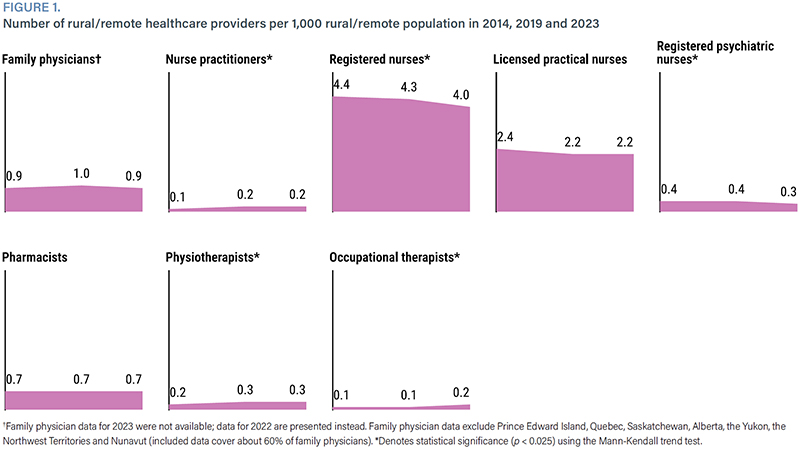
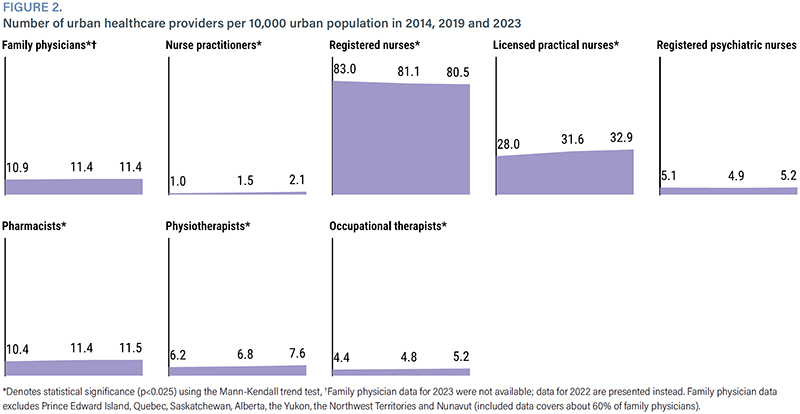
Current findings primarily rely on supply data, offering only a partial understanding of the geographic distribution of the health workforce. Expanding data collection is necessary to gain a more comprehensive picture. The 2022 HWI-MDS introduces new variables, such as the organization identifier, which identifies a provider's primary site of practice and expands on the previously collected place of work variable, allowing providers to report up to three work locations – while previously being able to report only one. Collecting this additional information will facilitate a clearer understanding of healthcare workforce distribution and workplace locations, supporting more effective resource planning and allocation, including efforts to address healthcare access in rural areas.
Composition: internationally educated health providers
Internationally educated healthcare providers (IEHPs) have long been a part of Canada's health workforce. IEHPs may enter Canada's health workforce through various pathways based on their profession and the jurisdiction in which they seek to practice.
In 2023, nearly 14% (n = 84,083) of healthcare workers in Canada were internationally educated. Over the past 10 years, the number of internationally educated family physicians remained stable, while almost all other professional groups saw an increase, the highest being among registered nurses, licensed practical nurses, pharmacists and physiotherapists. As Canada's population continues to grow and the complexity of care increases, reliance on a greater number of IEHPs may be required (CIHI 2024c).
To ensure equitable access to healthcare services, it is essential to recognize Canada's diverse population and consider needs, such as language requirements, to support ongoing improvements in care delivery. The updated HWI-MDS now collects data on up to three languages in which a provider can deliver services – an advancement, as previously, no language collection was conducted. This data will be crucial for facilitating effective communication between patients and providers, which can reduce unintended harm and promote improved health outcomes and patient safety (CIHI 2024d).
Language data can also inform strategic workforce placement of IEHPs by aligning providers' language abilities with the needs of various regions, addressing the needs of patients who may have difficulty communicating in Canada's official languages (CIHI 2024d).
Advancements in Pan-Canadian Health Workforce Data
Comprehensive, standardized, pan-Canadian data is required to effectively plan and manage the supply and sustainability of the Canadian health workforce. This article presents findings based on the most recent data available under the existing standard. While the existing standard provides essential information, the updated HWI-MDS will provide deeper insights to address health system challenges. Interest in the standard is strong, and adoption and implementation by data partners continue to grow rapidly. Stay tuned for future releases posted to CIHI's Health Workforce webpage (CIHI n.d.a) in 2025 that incorporate newly acquired HWI-MDS data.
Pan-Canadian adoption of the standard, along with the establishment of Health Workforce Canada (HWC 2024), promises to improve strategic planning, policy and decision making by delivering high-quality, comparable and linkable health workforce data. No one organization or government can solve this problem alone – it will take collective action and quality data to make a meaningful difference when it comes to Canada's health workforce.
About the Author(s)
Tyler Pirie, MSc, is a program lead in the health workforce information branch at Canadian Institute for Health Information (CIHI) in Ottawa, ON. Tyler can be reached by e-mail at tpirie@CIHI.ca.
Agata Logvin, MSc, is a senior analyst in the health workforce information branch at CIHI in Ottawa, ON.
Romaisa Pervez, MSc, is a senior analyst in the health workforce information branch at CIHI in Toronto, ON.
Shannon Weir-Seeley, MSc, is the manager of Data Development, Health Workforce Information at CIHI in Toronto, ON.
Laura Salter, MSc, is a program lead in the health workforce information branch at CIHI in Ottawa, ON.
Gregory Feng, MPH, is a senior analyst in the health workforce information branch at CIHI in Toronto, ON.
Cathy Huynh, BA, is a program specialist in the health workforce information branch at CIHI in Ottawa, ON.
Andrew McCabe, BMath, is a senior analyst in the health workforce information branch at CIHI in Ottawa, ON.
Chantal Couris, Phd, is a senior consultant with Strategic Initiatives, Data Strategies and Statistics Division at CIHI in Toronto, ON.
Natalie Damiano, MSc, is the director in the health workforce information branch at CIHI in Ottawa, ON.
References
Canadian Institute for Health Information (CIHI). n.d.a. Health Workforce Information. Retrieved February 12, 2025. <https://www.cihi.ca/en/topics/health-workforce>.
Canadian Institute for Health Information (CIHI). n.d.b. Health Human Resources Minimum Data Set – Data Dictionary. Retrieved February 12, 2025 <https://www.cihi.ca/sites/default/files/document/points-of-interest-health-human-resources-minimum-data-set-bulletin-en.pdf>
Canadian Institute for Health Information (CIHI). 2022, November 24. Health Workforce in Canada: Overview. Retrieved February 12, 2025. <https://www.cihi.ca/en/health-workforce-in-canada-overview>.
Canadian Institute for Health Information (CIHI). 2023. About the 2022 Health Human Resources Minimum Data Set Data Standard [Infosheet]. Retrieved February 12, 2025. <https://www.cihi.ca/sites/default/files/document/hhr-mds-data-standard-infosheet-en.pdf>.
Canadian Institute for Health Information (CIHI). 2024a, December 5. Access to Primary Care: Many Canadians Face Challenges. Retrieved January 30, 2025. <https://www.cihi.ca/en/primary-and-virtual-care-access-emergency-department-visits-for-primary-care-conditions/access-to-primary-care-many-canadians-face-challenges>.
Canadian Institute for Health Information (CIHI). 2024b, December 17. Health Workforce: Places of Work. Retrieved January 30, 2025. <https://www.cihi.ca/en/the-state-of-the-health-workforce-in-canada-2023/health-workforce-places-of-work>.
Canadian Institute for Health Information (CIHI). 2024c, December 17. Health Workforce: Recruitment and Retention. Retrieved January 30, 2025. <https://www.cihi.ca/en/the-state-of-the-health-workforce-in-canada-2023/health-workforce-recruitment-and-retention>.
Canadian Institute for Health Information (CIHI). 2024d, October 17. Patients with Language Barriers at Higher Risk of Experiencing Unintended Hospital Harm. Retrieved February 12, 2025. <https://www.cihi.ca/en/news/patients-with-language-barriers-at-higher-risk-of-experiencing-unintended-hospital-harm>.
Canadian Institute for Health Information (CIHI). 2024e, December 17. The State of the Health Workforce in Canada, 2023. Retrieved January 30, 2025. <https://www.cihi.ca/en/the-state-of-the-health-workforce-in-canada-2023>.
Clark, K., P. St. John, V. Menec, D. Cloutier, N. Newall, M. O'Connell et al. 2021. Healthcare Utilisation Among Canadian Adults in Rural and Urban Areas – The Canadian Longitudinal Study on Aging. Canadian Journal of Rural Medicine 26(2): 69–79. doi:10.4103/CJRM.CJRM_43_20.
Health Workforce Canada (HWC). 2024. About Us. Retrieved February 11, 2025. <https://healthworkforce.ca/about-us/>.
Statistics Canada. 2022, October 26. The Canadian Census: A Rich Portrait of the Country's Religious and Ethnocultural Diversity. Retrieved February 11, 2025. <https://www150.statcan.gc.ca/n1/daily-quotidien/221026/dq221026b-eng.htm>.
Comments
Be the first to comment on this!
Personal Subscriber? Sign In
Related Articles


Note: Please enter a display name. Your email address will not be publically displayed